ABOUT
Artist behind Primal Resonance.
I play the didgeridoo. Quite a lot, these days.
What started as a sound I remembered from childhood has gradually become a much bigger part of my life. It’s something I practise, perform, teach and share with other people, while somehow feeling like I’m only just beginning to understand it.

HOW I GOT HERE

The first time I heard a didgeridoo I was about seven, on Glastonbury Tor.
Someone was playing and a small crowd had gathered around him. I didn’t really understand what I was looking at, but I remember the sound. It was low, physical and completely unlike anything else I had heard. I was truly mesmerised. I also remember looking at my parents and realising they were just as captivated by it.
Years later, when I was about thirteen, I spotted a bamboo didgeridoo in a shop for about £15. I bought it, took it home and immediately discovered that owning a didgeridoo and being able to play one are two quite different things.
The noise I produced was fairly pathetic. Circular breathing seemed impossible.
Before long, the didgeridoo ended up behind my wardrobe.
A few years passed.
Then one day I heard someone busking with a didgeridoo in town. I recognised the sound before I really registered where it was coming from, and suddenly that first memory came back.
I went home, retrieved the didgeridoo from its long and distinguished career behind the wardrobe, and decided that this time I was actually going to learn.
Progress was slow at first. I practised every day and spent months trying to circular breathe before it finally began to click. I explored the instrument on my own for a while, then found a teacher, and somewhere along the way became slightly obsessed.
And once the basics started to settle, the instrument seemed to get bigger rather than smaller.
Rhythm, overtones, voice, breath, movement, improvisation. Every time I thought I understood a little more of it, another direction opened up.
MY APPROACH
What I hadn’t expected was everything that would come with learning the instrument.
I started discovering contemporary players taking the didgeridoo in directions I hadn’t imagined. Players like Zalem Delarbre and Dubravko Lapaine completely changed my sense of what could be done with it.
I went to festivals, took lessons, met musicians whose playing I had previously known only through recordings and videos, and gradually found myself becoming part of a world I had once been looking into from the outside.
Meeting Zalem was one of those slightly surreal moments. I’d listened to his playing for years, and then suddenly I was sitting down jamming with him.
Experiences like that have made me realise how far this one instrument has taken me. Not just musically, but into friendships, places, communities and experiences I probably wouldn’t otherwise have found.
And I’m still finding them.
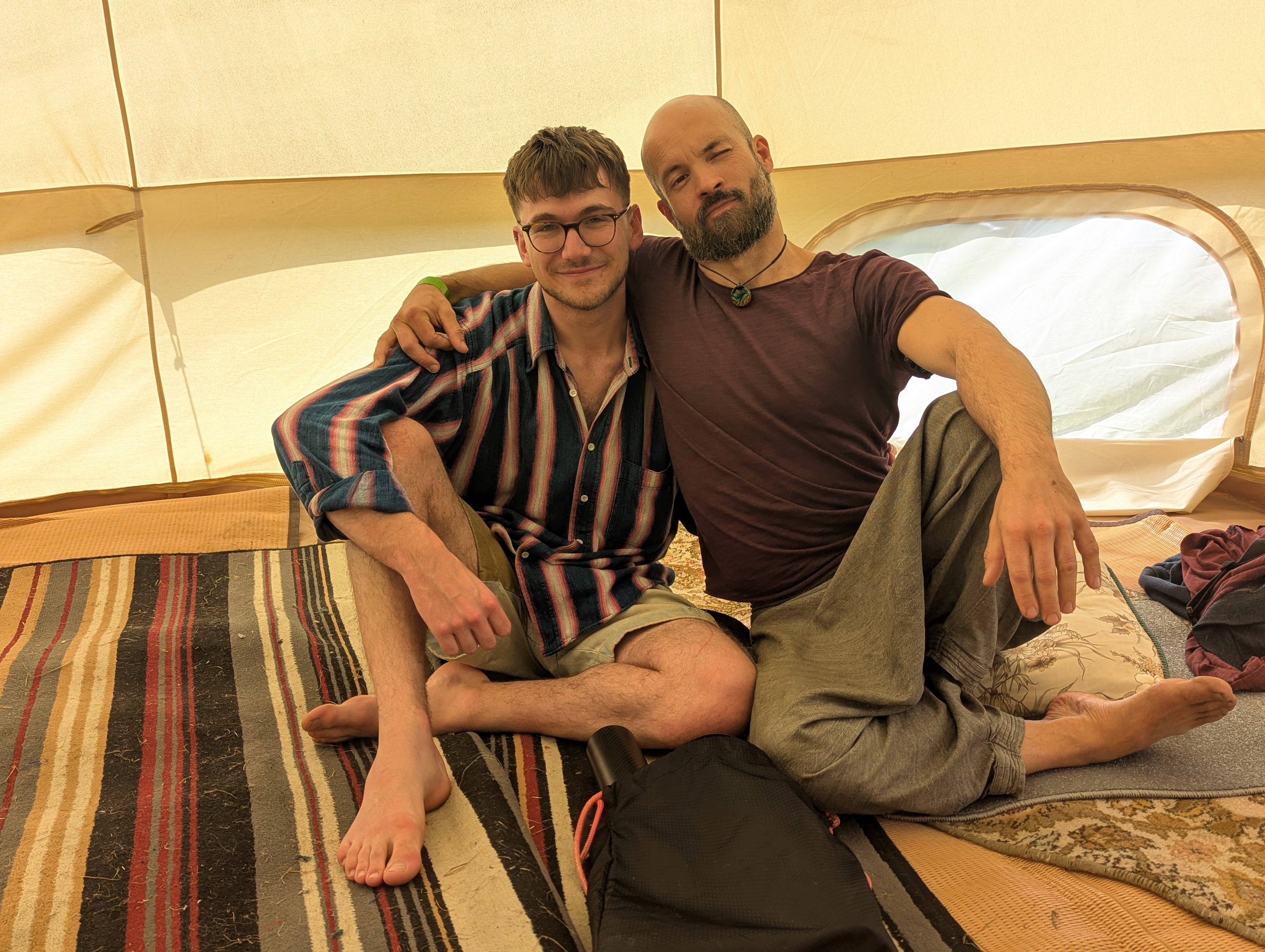
With contemporary didgeridoo player Dubravko Lapaine.
TEACHING & COMMUNITY

The community around the didgeridoo has become almost as important to me as playing it.
At first, I mostly turned up because I wanted to learn. Over time I found myself wanting to contribute as well. That has grown into teaching, running workshops, organising community sessions, performing with other musicians and finding ways for more people to come together and play.
I’m still relatively young in the didgeridoo world, and there are people around me who have been playing for longer than I’ve been alive. I like that. There is a huge amount of knowledge to learn from, but I also feel some responsibility to help carry things forward and make spaces for new people to discover the instrument.
One of the things I particularly love about the didgeridoo community is that the instrument can be taken very seriously without everyone around it having to become terribly serious.
Someone can spend years developing astonishing technique and, five minutes later, sit in a circle next to somebody who has only just worked out how to make a drone.
There’s room for both.
That’s a spirit I want to help keep alive, while also seeing where the instrument, the music and the community might go next.
CONTEXT & RESPECT
The didgeridoo originates in the Aboriginal cultures of northern Australia, although even the word didgeridoo is not an Aboriginal word.
Different peoples have their own names, traditions and relationships with the instrument. Yidaki, for example, belongs to Yolŋu culture in north-east Arnhem Land, while mago is associated with other traditions in northern Australia.
These traditions are far older and richer than the contemporary didgeridoo world I play in. In their original cultural contexts, these instruments are not simply standalone musical instruments, but can be connected with song, ceremony, community and cultural life.
I play as a contemporary, non-Indigenous musician.
For me, respecting the instrument means being clear about that distinction, continuing to learn about its origins and history, and making sure that history doesn’t disappear when the instrument is played in new contexts.
The funny thing is that the more time I spend with the didgeridoo, the less finished it feels.
There are still sounds I can’t quite make, rhythms I want to understand, players who completely rearrange my idea of what is possible, people I want to make music with and directions I haven’t explored yet.
I suspect there always will be.
And the idea that I could spend the rest of my life going deeper into one instrument and still never quite reach the end of it genuinely delights me.